
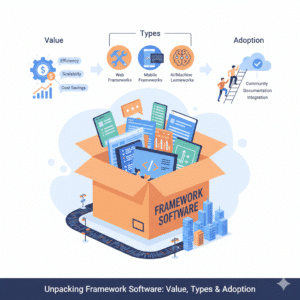
In the dynamic realm of software development, efficiency and reliability are paramount. Framework software stands as a cornerstone in achieving these goals, providing developers with a structured foundation upon which to build robust applications. This article delves into the essence of frameworks, exploring their fundamental role, diverse applications, and profound impact on modern development methodologies, offering a comprehensive understanding of their indispensable value.
Understanding Framework Software: The Foundation of Modern Development
Framework software represents a paradigm shift in how applications are constructed, moving beyond the traditional approach of building everything from scratch. At its core, a framework is a pre-defined, reusable architectural structure that provides a generic functionality, offering a skeleton upon which developers can custom-fit their application-specific logic. Unlike a mere library, which is a collection of functions or classes that you call when needed, a framework employs the “Hollywood Principle” – “Don’t call us, we’ll call you.” This means the framework dictates the flow of control, calling your code at specific points to execute custom logic, thereby guiding the entire development process.
This inverted control structure is precisely what imbues frameworks with their power and utility. They don’t just provide tools; they provide a methodology. Imagine constructing a multi-story building. A library might offer you individual bricks, cement, and specialized tools. A framework, however, provides the complete structural steel skeleton, including pre-fabricated floors and designated spaces for plumbing and electrical wiring. Your job as a developer then shifts from fundamental engineering to filling in the specific details and customizations within that robust, pre-established architecture. This dramatically accelerates development by handling common, repetitive tasks and architectural decisions that would otherwise consume significant time and resources.
The benefits derived from adopting framework software are multifaceted and deeply impactful on project outcomes. Firstly, and perhaps most immediately apparent, is the substantial increase in productivity. By abstracting away much of the boilerplate code and common infrastructure, developers can focus their energy on the unique, business-logic aspects of their application. Tasks such as database connectivity, routing HTTP requests, handling user authentication, managing sessions, or rendering user interfaces are often pre-built and optimized within a framework. This “don’t reinvent the wheel” philosophy means features can be implemented faster, reducing time-to-market and allowing development teams to achieve more with less effort.
Secondly, frameworks are instrumental in enforcing standardization and best practices. They often come with an opinionated view on how an application should be structured and how certain problems should be solved. This consistency across a codebase, especially in larger teams, is invaluable. It leads to more maintainable code, as developers can quickly understand and navigate unfamiliar parts of an application because they adhere to a consistent architectural pattern. This consistency also reduces the likelihood of introducing common errors or security vulnerabilities, as the framework’s core often undergoes rigorous testing and continuous improvement by a wider community of contributors. Furthermore, onboarding new team members becomes significantly smoother, as they can leverage existing knowledge of the framework rather than having to learn bespoke architectural patterns for each new project.
Thirdly, frameworks often enhance scalability and maintainability. Applications built on well-designed frameworks tend to be more modular and easier to scale. The clear separation of concerns that many frameworks promote (e.g., Model-View-Controller or component-based architectures) allows for independent development and deployment of different parts of an application. When an application needs to grow, extending specific modules or features is more straightforward due to the underlying structure. Moreover, ongoing maintenance is simplified because bugs can often be isolated to specific components, and updates or patches can be applied with less risk of breaking unrelated functionalities.
Finally, frameworks often provide inherent security features and robust community support. Many popular frameworks include built-in defenses against common web vulnerabilities such as SQL injection, cross-site scripting (XSS), and cross-site request forgery (CSRF). While not a complete panacea, these features significantly reduce the attack surface and provide a solid security baseline. Beyond code, the vast ecosystems surrounding most major frameworks offer extensive documentation, tutorials, forums, and a vibrant community of developers. This means that when developers encounter challenges, solutions or guidance are often readily available, accelerating problem-solving and fostering a collaborative learning environment. This collective intelligence and continuous refinement are critical for the long-term viability and security of any software project.
Exploring Types, Ecosystems, and Strategic Adoption
The landscape of framework software is incredibly diverse, categorized primarily by the domain or platform they target. Understanding these distinctions is crucial for making informed decisions about which framework to adopt for a given project. The proliferation of frameworks reflects the varied needs and complexities inherent in different areas of software development, each designed to optimize specific workflows and address particular challenges.
In the realm of web application development, frameworks are broadly divided into backend and frontend categories. Backend frameworks, such as Django (Python), Ruby on Rails (Ruby), Spring Boot (Java), and Laravel (PHP), focus on server-side logic, database interaction, API creation, and security. They provide comprehensive tools for handling HTTP requests, managing data persistence, and building robust server infrastructure. Frontend frameworks like React, Angular, and Vue.js (all JavaScript-based) specialize in building interactive and dynamic user interfaces that run in the browser. They offer component-based architectures, state management solutions, and efficient rendering mechanisms to deliver rich user experiences. The strategic choice between full-stack frameworks (which often encompass both backend and frontend, or at least provide strong integrations) and separate, specialized frameworks depends heavily on project scope, team expertise, and desired level of control.
Mobile development frameworks similarly offer specialized solutions. For native applications, developers often leverage platform-specific SDKs (Software Development Kits) which include frameworks like Apple’s UIKit/SwiftUI for iOS and Google’s Android SDK/Jetpack Compose for Android. These provide unparalleled access to device features and native performance. However, for cross-platform development, frameworks such as React Native, Flutter, and Xamarin allow developers to write code once and deploy it on multiple platforms (iOS and Android), significantly reducing development time and cost, albeit sometimes with a slight trade-off in native look-and-feel or access to bleeding-edge device features.
Beyond web and mobile, frameworks extend to desktop application development (e.g., Electron for cross-platform web technologies, Qt for C++, or .NET Framework/WPF for Windows), and even highly specialized domains like data science and machine learning. Here, frameworks such as TensorFlow and PyTorch (for deep learning), or Scikit-learn (for traditional machine learning), provide optimized libraries and structures for building, training, and deploying complex AI models, abstracting away the underlying mathematical and computational complexities.
Crucial to the longevity and utility of any framework is its ecosystem. An ecosystem encompasses not just the core framework code, but also a vast network of ancillary tools, libraries, plugins, community forums, extensive documentation, and third-party integrations. A thriving ecosystem signifies a healthy, active project with ongoing development, strong support, and a rich array of resources that can extend the framework’s capabilities. A robust ecosystem minimizes the need for developers to build utilities from scratch, fostering rapid development and ensuring that common problems already have well-vetted solutions.
The strategic adoption of a framework requires careful consideration. Several factors weigh into this critical decision. Firstly, the project requirements are paramount: Is it a simple prototype or a large-scale enterprise application? What are the performance needs, security demands, and scalability expectations? An overly complex framework might introduce unnecessary overhead for a small project, while a minimalist one might lack the necessary features for a large-scale system. Secondly, team expertise and existing skill sets play a significant role. Leveraging a framework that the development team is already proficient in can drastically reduce the learning curve and accelerate initial development. Investing in a new framework requires allocating time for training and skill acquisition. Thirdly, evaluating the community support and long-term viability of a framework is essential. Is it actively maintained? Does it have a large and engaged community? Are there frequent updates and security patches? A framework with waning support could become a liability over time.
Furthermore, developers must consider the framework’s opinionated nature versus its flexibility. Some frameworks are highly opinionated, dictating specific ways of doing things, which can be great for consistency and speed but might be restrictive if unique architectural choices are desired. Others are more flexible, offering a multitude of approaches, which provides freedom but requires more architectural decision-making from the development team. Finally, licensing considerations and potential “framework lock-in” are important. While frameworks provide immense benefits, becoming overly reliant on a specific framework’s proprietary features can make it challenging and costly to migrate to a different technology stack later if project needs evolve or the framework becomes obsolete. Therefore, understanding the potential trade-offs and diligently evaluating a framework’s alignment with long-term strategic goals are vital for successful adoption and sustainable software development.
In summary, framework software has fundamentally reshaped modern software development, offering structured environments that significantly boost productivity, enforce best practices, and enhance application quality. From web and mobile to specialized domains, these architectural foundations provide immense value by abstracting complexities and fostering robust ecosystems. Strategic adoption, carefully weighing project needs, team expertise, and long-term viability, ensures that frameworks remain an indispensable asset in navigating the ever-evolving technological landscape, empowering developers to build sophisticated solutions efficiently and reliably.