
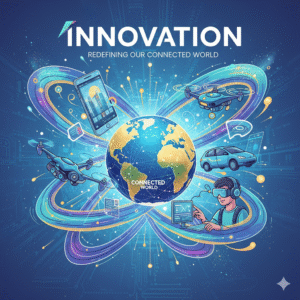
The relentless pace of innovation ensures a continuous stream of new gadgets redefining our world. From enhancing daily convenience to revolutionizing industries, these technological marvels shape how we live, work, and interact. This article delves into the exciting landscape of emerging devices, exploring their profound impact and the future they are actively building.
The Transformative Power of Innovation: Redefining Everyday Life
New gadgets are no longer just incremental upgrades; they represent fundamental shifts in how we experience technology, seamlessly integrating into the fabric of our personal lives. These innovations aim to make our environments smarter, our health more manageable, and our personal computing more intuitive and powerful than ever before.
One of the most rapidly evolving sectors is smart home technology, moving far beyond simple remote control. Today’s smart home ecosystems are increasingly autonomous, predictive, and personalized. Advanced smart thermostats, for instance, don’t just respond to schedules; they learn your preferences over time, integrating with weather forecasts and even occupancy sensors to optimize energy consumption while maintaining peak comfort. Integrated security systems now incorporate sophisticated AI-driven analytics, distinguishing between pets and intruders, offering facial recognition for family members, and providing proactive alerts rather than mere passive monitoring. Smart appliances are gaining intelligence too, offering features like remote diagnostics, optimized cooking cycles based on ingredients scanned, and even suggesting recipes. Voice assistants are becoming more contextual, understanding complex commands and initiating routines that anticipate user needs, blurring the lines between convenience and genuine assistance. The goal is an environment that adapts to you, rather than the other way around, prioritizing efficiency, security, and an almost invisible layer of support.
Wearable technology has also transcended its early focus on basic fitness tracking. Modern smartwatches and health bands are evolving into sophisticated personal health hubs. Beyond monitoring steps and heart rate, many now offer electrocardiogram (ECG) capabilities to detect atrial fibrillation, blood oxygen saturation (SpO2) tracking, and even continuous glucose monitoring (CGM) through non-invasive or minimally invasive sensors. These devices are becoming crucial tools for proactive health management, providing users and their doctors with unprecedented insights into well-being. Furthermore, the advent of augmented reality (AR) and virtual reality (VR) glasses is pushing wearables into new dimensions. While still nascent for widespread consumer adoption, future iterations promise seamless integration of digital information with the physical world, offering hands-free navigation, real-time language translation, and immersive entertainment or productivity experiences directly within our field of vision. Imagine receiving contextual information about your surroundings or collaborating in a virtual meeting with colleagues appearing as lifelike avatars, all through a lightweight pair of glasses.
The landscape of personal computing — encompassing smartphones, laptops, and tablets — continues its profound evolution. While raw processing power remains a driving factor, the focus has shifted towards versatility, battery efficiency, and intelligent features. Foldable smartphones and laptops, once a futuristic concept, are now a reality, offering larger screen real estate in compact form factors, fundamentally altering how we consume and create content on the go. Devices are increasingly integrating dedicated AI co-processors, enabling advanced computational photography that rivals professional cameras, real-time language processing, and personalized user interfaces that learn from your habits. Haptic feedback systems are becoming more nuanced, providing tactile sensations that enhance immersion in games and provide subtle confirmations for interface interactions. Displays are pushing boundaries with higher refresh rates, brighter panels, and deeper color accuracy, making every visual experience more vibrant. Battery technologies are advancing, not just in capacity but in faster charging speeds and more efficient power management, allowing us to stay connected and productive for longer without interruption. The convergence of these innovations means our personal devices are becoming more than tools; they are intelligent companions, adapting to our workflows and personalizing our digital lives in unprecedented ways.
Beyond Personal Use: Gadgets Shaping Industries and Futures
While new gadgets significantly enhance our personal lives, their impact extends far beyond individual convenience, driving transformative changes across industries and shaping the very fabric of our collective future. The synergistic integration of artificial intelligence, a burgeoning commitment to sustainability, and unprecedented levels of connectivity are pivotal in this next wave of innovation.
The pervasive integration of Artificial Intelligence (AI) and automation is perhaps the most significant force driving the evolution of new gadgets. AI is no longer confined to vast cloud servers; it’s increasingly embedded directly into devices, a concept known as “edge AI.” This allows gadgets to process information locally, enabling faster responses, enhanced privacy, and operation even without an internet connection. In smartphones, AI co-processors power advanced computational photography, capable of intricate image processing like segmenting subjects from backgrounds, enhancing low-light performance, and even generating realistic depth effects. Beyond consumer devices, AI-powered robotics are revolutionizing manufacturing, logistics, and even healthcare, performing complex tasks with precision and efficiency. Autonomous drones, equipped with AI for navigation and object recognition, are being deployed for everything from infrastructure inspection and agricultural monitoring to last-mile delivery. These gadgets, imbued with intelligent decision-making capabilities, are not just performing tasks but learning and adapting, leading to more efficient, safer, and more productive operations across various sectors.
Alongside technological prowess, there’s a growing emphasis on sustainability and ethical considerations in gadget design. Consumers and regulators are increasingly demanding eco-friendlier products, prompting manufacturers to innovate in materials, manufacturing processes, and product lifecycles. New gadgets are now being designed with recycled plastics, rare-earth metals, and other sustainable components, reducing their environmental footprint. The concept of “repairability” is gaining traction, with some companies offering modular designs or easily accessible parts, challenging the traditional “throwaway” culture. Longer software support cycles are also becoming a crucial aspect of sustainability, extending the useful life of devices. Beyond environmental impact, ethical concerns regarding data privacy and security are paramount, especially as more interconnected gadgets collect sensitive personal information. Manufacturers are responding by implementing robust encryption, secure boot processes, and clear privacy policies, striving to build trust in an increasingly interconnected world. The future of gadgets is not just about what they can do, but how responsibly they are made and used.
The foundation for many of these advancements lies in ever-improving connectivity and the emergence of spatial computing. Technologies like 5G, Wi-Fi 7, and even satellite internet are providing unprecedented bandwidth and ultra-low latency, which are critical enablers for next-generation gadgets. This enhanced connectivity fuels real-time applications such as high-fidelity augmented and virtual reality experiences, where data must be streamed instantaneously to avoid motion sickness and maintain immersion. It also empowers cloud-based gaming and productivity applications, allowing powerful computations to occur remotely while accessible via lightweight, energy-efficient devices. The concept of “spatial computing” is perhaps the most profound long-term trend, merging the digital and physical worlds into a seamless, interactive environment. Future gadgets, like advanced AR glasses, will allow users to interact with digital content (e.g., virtual screens, 3D models) anchored in their physical surroundings, transforming how we work, learn, and socialize. Imagine navigating a city with dynamic overlays of information, collaborating with remote colleagues in a shared virtual workspace, or learning a new skill with interactive 3D tutorials projected right before your eyes. This evolution of connectivity and interaction paradigms promises to redefine our relationship with information and each other, pushing the boundaries of what gadgets can facilitate.
The world of new gadgets is a vibrant testament to human ingenuity, constantly pushing boundaries and redefining possibilities. From enhancing our personal health and home environments to revolutionizing industries with AI and fostering sustainable practices, these innovations are profoundly shaping our present and future. As connectivity strengthens and intelligent design deepens, we can expect a continued evolution, making our lives richer, more efficient, and undeniably more connected.