
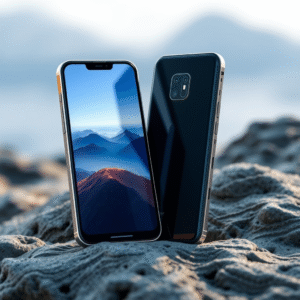
The year 2025 looms large on the horizon, promising a new wave of innovation in the fiercely competitive smartphone market. As technology continues its relentless march forward, anticipating the “best” smartphones of tomorrow requires a keen eye on emerging trends, design philosophies, and groundbreaking advancements. This article delves into the transformative technologies and design principles that will define the elite devices consumers will clamor for, offering a comprehensive look at the future of mobile communication.
The Dawn of Next-Gen Innovation: Defining the 2025 Smartphone Experience
By 2025, the smartphone landscape will have evolved beyond incremental upgrades, ushering in a new era where seamless integration of advanced technologies, heightened intelligence, and unparalleled user experiences take center stage. The definition of a “best” smartphone will extend far beyond raw specifications, encompassing an intricate blend of hardware prowess, sophisticated software, and a commitment to user-centric design.
One of the most profound shifts will be in the realm of Artificial Intelligence (AI). While AI has been a buzzword for years, by 2025, it will be deeply embedded at the hardware level, powered by significantly more capable neural processing units (NPUs) within custom chipsets. This on-device AI will enable hyper-personalized experiences, understanding user habits and preferences with unprecedented accuracy. Imagine a smartphone that proactively manages your daily schedule, optimizes battery usage based on your predicted needs, and even generates custom content or edits photos and videos with a single, intuitive command. Computational photography, already impressive, will reach new heights, allowing for real-time scene understanding, advanced object removal, and even generative fill capabilities that seamlessly integrate into the captured image or video. AI will also power more natural and context-aware voice assistants, moving beyond simple command recognition to true conversational intelligence.
Display technology will continue its breathtaking evolution. We anticipate under-display camera technology to be virtually indistinguishable, allowing for truly bezel-less, notch-free, and punch-hole-free full-screen experiences across premium devices. Beyond aesthetics, advancements in panel materials and manufacturing will lead to even more vibrant colors, perfect blacks, and significantly higher peak brightness levels, crucial for both outdoor visibility and immersive HDR content. Dynamic refresh rates, already a premium feature, will become even more refined, potentially spanning from an energy-saving 1Hz for always-on displays to ultra-smooth 144Hz or even higher for demanding gaming. Furthermore, expect greater durability with new generations of Gorilla Glass or equivalent protective layers, and perhaps the mainstreaming of variable form factors like more robust foldables, rollables, or even dynamically morphing screens that adapt to usage scenarios, offering both compact portability and expanded screen real estate.
Under the hood, processor efficiency and raw power will continue to be a battleground. Custom silicon, like Apple’s A-series and Google’s Tensor chips, will push the boundaries of what’s possible on a mobile device. Expect multi-core architectures to further specialize, with dedicated cores for graphics, AI, security, and image processing working in harmony. This will translate into desktop-class performance for complex applications, console-level graphics for mobile gaming with features like hardware-accelerated ray tracing, and incredibly fluid multitasking. Energy efficiency will be paramount, driven by advanced manufacturing processes (e.g., 2nm or even 1.x nm nodes) to maximize performance while minimizing thermal output and extending battery life.
Battery technology and charging speeds will also see significant leaps. While breakthroughs in solid-state batteries might still be a few years from widespread commercialization, advancements in traditional lithium-ion chemistries, coupled with sophisticated power management AI, will deliver longer lasting devices. Ultra-fast wired charging (e.g., 150W+ becoming common) will mean a full charge in mere minutes, while wireless charging will become faster, more efficient, and potentially extend to greater distances. Reversible wireless charging will be standard, allowing phones to power accessories or even other phones with ease.
The camera system, often a primary differentiator, will continue its exponential improvement. Beyond higher megapixel counts, expect larger sensors to become more common, capturing significantly more light and detail, especially in challenging conditions. Advanced optical stabilization, possibly involving micro-gimbals, will be standard for both photos and videos. Periscope zoom lenses will offer even greater optical magnification, while computational photography will blend data from multiple lenses and AI to create images that far surpass what raw optics alone can achieve. Video recording will see higher resolutions (e.g., 8K at 60fps across more devices), enhanced dynamic range, and professional-grade editing tools built directly into the phone’s software. Furthermore, expect augmented reality (AR) capabilities to be deeply integrated with cameras, transforming how we interact with the real world through our devices.
Finally, connectivity will be bolstered with the widespread adoption of Wi-Fi 7, offering dramatically lower latency and higher throughput. Early forms of 6G communication might begin to emerge in experimental devices, pushing data speeds to unimaginable levels. Satellite connectivity, already making inroads for emergency services, could expand to offer basic communication in remote areas, enhancing safety and accessibility.
Projecting the Powerhouses: Anticipated Flagship Contenders of 2025
Based on the technological trajectory, several key players are poised to lead the charge in 2025, each with their distinct strengths and strategies for capturing the premium market.
The Apple iPhone 17 Pro Max (or equivalent) will likely set the benchmark for integrated hardware and software. Powered by an unparalleled custom A-series chip, it will deliver industry-leading performance, especially for demanding tasks like AR applications and high-fidelity gaming. Expect an even more refined ProMotion XDR display, possibly with fully integrated under-display Face ID and front camera. Apple’s computational photography will continue to be a strong suit, enhanced by its powerful NPU for advanced image and video processing. The ecosystem integration, privacy features, and robust software updates will remain core differentiators. We might see further advancements in satellite communication, expanding beyond emergency services, and perhaps more sophisticated health monitoring sensors.
Samsung’s Galaxy S25 Ultra and its next-generation foldable devices like the Galaxy Z Fold 7 are expected to push boundaries with display innovation and versatility. The S25 Ultra will likely feature an even more sophisticated multi-camera array, with revolutionary periscope zoom capabilities and significantly larger main sensors, leveraging Samsung’s expertise in mobile photography. The S-Pen integration will be more fluid and feature-rich. Samsung’s foldable line will be remarkably more durable, thinner, and lighter, potentially integrating new form factors like rollable displays that provide an even larger canvas when needed, making them more mainstream propositions. One UI, enhanced by powerful on-device AI, will offer a highly customizable and feature-rich Android experience, coupled with robust security features like Knox.
Google’s Pixel 10 Pro will continue its focus on being the ultimate “AI Phone.” Its third or fourth-generation Tensor chip will be an even greater powerhouse for on-device machine learning, enabling groundbreaking advancements in real-time translation, advanced voice processing, and hyper-intelligent computational photography that goes beyond mere enhancement to truly transformative image creation. Expect unparalleled integration with Google’s services, a pure Android experience with exclusive AI-powered features, and potentially unique hardware designs that differentiate it from the competition. Google’s dedication to robust security and long-term software support will also be key selling points.
Other Android powerhouses like Xiaomi, OnePlus, Oppo, and Vivo will continue to challenge the incumbents by specializing in certain areas. Xiaomi, for instance, might push the limits of ultra-fast charging even further, perhaps making 200W+ charging a reality, alongside cutting-edge camera sensors developed in partnership with imaging giants. OnePlus will likely focus on delivering an incredibly fluid user experience with OxygenOS, prioritizing raw speed and potentially evolving its gaming-centric features. Oppo and Vivo could lead with innovative camera mechanics, unique design elements, and advanced display technologies, perhaps even being first to market with truly innovative battery solutions or new biometric authentication methods. These brands will often offer compelling alternatives, pushing the envelope in specific performance metrics or providing exceptional value propositions.
In essence, the “best” smartphones of 2025 will not be defined by a single metric but by a holistic experience where cutting-edge hardware, intelligent software, and intuitive design converge. They will be devices that anticipate our needs, enhance our creativity, and seamlessly integrate into every aspect of our digital lives, pushing the boundaries of what we expect from a pocket-sized supercomputer.
The 2025 smartphone landscape promises remarkable innovation, with AI, advanced displays, and powerful custom silicon driving unprecedented user experiences. Leading brands like Apple, Samsung, and Google will continue to redefine performance, photography, and intelligent features, while others push boundaries in niche areas. Ultimately, the best devices will offer a seamless blend of cutting-edge technology and intuitive design, setting new standards for connectivity, productivity, and personal interaction in our increasingly digital world.